The lead up to and the Battle of Omdurman - The Sudan
Related
Related Locations
On the 22nd August 1898, the 2nd Bn The XX Lancashire Fusiliers had spent the night at Wad Hamed, having arrived there at 06oo hrs on the 21st August, travelling up the river on the gunboat " Fatteh", which had two barges and two gyasses lashed alongside.
It had been an uncomfortable journey, 660 men standing 3 deep with no room to sit or lie.
At stand to on the 22nd, each man had a full kit, and each man carried a second haversack in which was a drinking tin,a muslin strainer,a greatcoat,helmet curtains and a pad to protect the back from the sun.
AS A DISTINCTIVE BADGE, A YELLOW PATCH WAS SEWN ON EITHER SIDE OF THE HELMET.
Reveille sounded at 0345 on the 23rd August and so began the epic action which would result at the battles end in 10,000 Dervishes dead, 16,000 wounded, and 5,000 prisoners.
On the 23rd, reveille sounded at 0345 hrs and an hour later the whole force paraded and were inspected by the Sirdar, Major General Sir H Kitchener KCB.
It was agreed by all who saw it to be a fine spectacle. This is what was meant by "The whole Force "
BRITISH TROOPS
21st Lancers.
32nd Field Battery, Royal Artillery.
37th Howitzer Battery, Royal Artillery.
2 40-prs., Royal Artillery.
Infantry Division,
1st Brigade.
1st Battalion Warwickshire Regiment.
1st Battalion Lincolnshire Regiment.
1st Battalion Seaforth Highlanders.
1st Battalion Cameron Highlanders.
6 Maxims.
Detachment, Royal Engineers.
2nd Brigade. 1st Battalion Grenadier Guards. 1st Battalion Northumberland Fusiliers. 2nd Battalion Lancashire Fusiliers. 2nd Battalion Rifle Brigade. 4 Maxims. Detachment, Royal Engineers.
EGYPTIAN TROOPS. 9 Squadrons, Cavalry. 1 Battery, Horse Artillery. 4 Field batteries. 10 Maxims. 8 Companies Camel Corps.
1st Brigade. 2nd Egyptian Battalion. 9th, 10th, and 11th Sudanese Battalions.
2nd Brigade. 8th Egyptian Battalion. 12th, 13th, and 14th Sudanese Battalions.
3rd Brigade. 3rd, 4th, 7th, and 15th Egyptian Battalions.
4th Brigade. 1st, 5th, 17th, and 18th Egyptian Battalions.
Camel Transport.
Imagine that lot, fully kitted out for war and lined up for inspection !
They then changed " quarter right" and in the execution of this simple movement the number of contradictory orders that emanated from the British Infantry were a cause of astonishment to the whole Division.
The day was spent following orders and counter orders which was described as being a"source of great irritation "to the Infantry, which they forcibly denounced in well known expletives.
Readers will I am sure recognise this this kind of situation ! ?
This day and the next were spent in formation drills and exercises ,using ball ammunition, and in testing communications.
The 2nd Bn of the XX had taken 2,500 gallons of reserve water with them, they would need every drop.
24th August The XX Lancashire Fusiliers spent this day bivouacced in scrub land, still some 40 miles away from Omdurman. A rehearsal of an attack using a 2 mile front was carried out in the afternoon. You may recall some of this period from the 1939 film "The 4 Feathers" (only the 1939 version uses actual historically accurate events leading up to Omdurman and was filmed in the general area of Omdurman)
The 25th August was spent in marching a little closer to where intelligence reports believed the Dervishes to be gathering.
At 0530 hrs the Division set off in a 3 column formation, The 2nd Bn XX on the left, the Grenadier Guards on the right and the Northumberland Fusiliers in the centre.
The enemy were reported to be approximately 40,000 strong. I bet this piece of information concentrated the minds of the LFs somewhat !
After marching for four and a half hours a halt was called and everyone bivvied up in the scrub.
26th August In an effort to save the men from the punishing ordeal of marching with full kit and ammunition in the heat of the day,it was decided that the marching to be done on the 26th August would not begin until 1600 hrs.
( I bet the cheer could have been heard in England !)
The Division marched in 3 columns as before until 1830 hrs and then, amidst much confusion,the Division formed a square and bivvied down.
At the last moment it was discovered that there was no wood available locally, consequently there were no fires and no tea or food could be made.
(I bet the resulting groan could have been heard in England )
The column was now just 6 miles from Gebel Royan, only 46 miles to Omdurman.
On the 27th August 1898, the men of the 2nd Bn The XX Lancashire Fusiliers made a short march of some 6 miles to Gebel Royan, they then spent the day making zaribas ( thorn barriers ) and shelters on the camping ground. At 1655, the Brigade marched to their new allocated position which was at Wady Abud, a mere 3 and a half hours march away, reaching there at 2030 hrs.
Just as they were all getting settled in, there was an alarm.
An Arab came charging through the lines shouting "Allah, Allah ". Captain Wolley-Dod of the XX ordered the men to hold their fire as he believed that the main body of enemy would not be far behind.
As it happened, the nutter was on his own, and having thrown his spear and having found his way into the history books he scarpered unhurt !
The 28th August and 29th August 1898 were spent in camp,cleaning and preparing weapons, rehearsing tactics etc. On the 30th August the whole force decamped and marched from 0530 until 1100 hrs, covering 13 miles ( remember in full kit and rationed water )
At this time , further misery befell them as Dysentery made it's appearance, no doubt due to the water problems. On August 31st reveille was at 0430 and at 0600 they began marching towards the enemy again. 2 hours later, they halted at a place called Kerriri (look it up ) by which time it was estimated that they were within 10 miles of the 45,000 strong enemy.
After a pause of an hour ,the march was resumed until they reached their camp site which had been marked out for them. When they rose from their bivvies on September 1st, it was persistantly pouring down, and the force marched to a position South and West of the village of Kerriri, with their backs to the river and they bivvied down on a 6 Company frontage
The 2nd September 1898 was a Friday.
At 0400 hrs, the Division was stood to, Lyttelton's Brigade was on the left of the Infantry position, with it's left thrown back to protect that flank. They had the Nile at their backs. The Brigade was formed as follows:- 2nd Rifle Brigade on the left, then 2LF, then 1RNF and 1 Warwicks on the right.
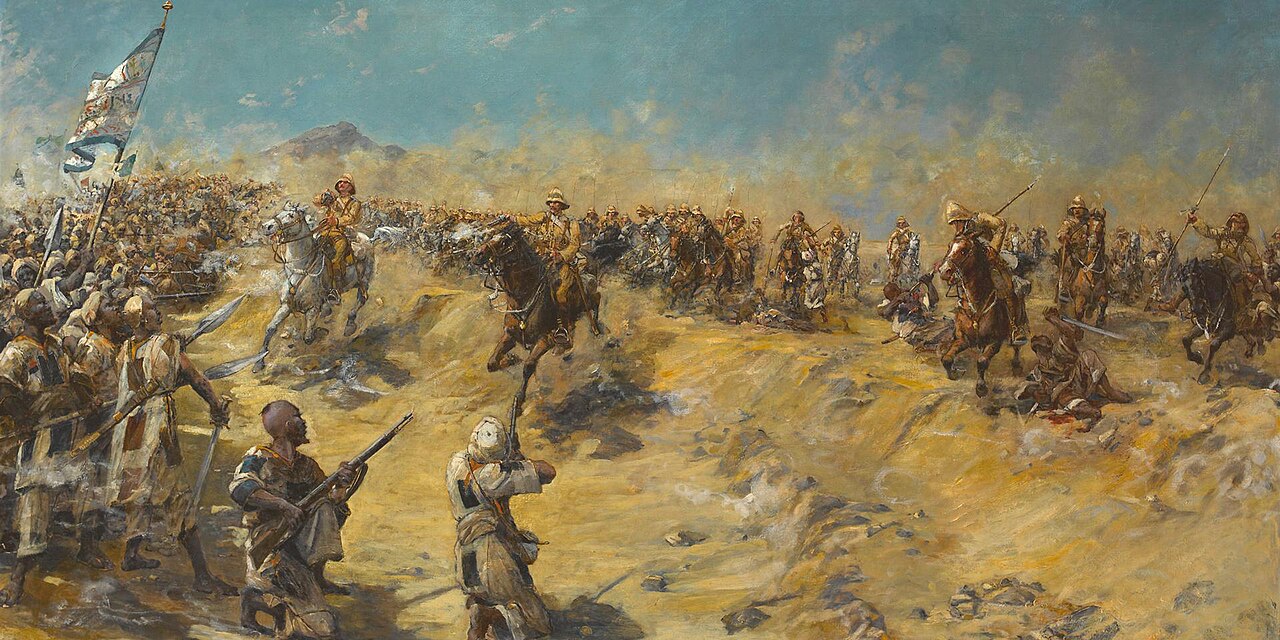
The Brigade had 6 companies in the front line and 2 companies in reserve. And so they waited...... At 0630 hrs,the first sighting of the enemy was made, a vast mass of Dervishes moving opposite the British centre. A vast multitude ,rushing onwards like a sea that nothing could stop, came the Dervish mass. At 0650 hrs the Artillery opened fire, along with the gunboats. At 0720, with the huge mass getting ever closer, 2LF were moved to the right of the 1st Brigade to strengthen the Camerons.
A Battery of guns was also placed here on the left,and the Rifle Brigade was also added to this flank. On the enemy came, with loud angry shouts, and bullets began to arrive amongst our troops. The concentrated fire of the whole front then engaged the enemy and when the smoke cleared it was clear that the enemy had suffered appalling casualties. They stopped, and surged backwards.
When the the cease fire sounded, only a few thousand of them were left firing from a depression in front of 2 LF. At 0900 hrs, the whole of our force moved to the left in echelon of Brigades to try and get between Omdurman and the remaining mass of enemy.
During this move the enemy attacked ,hurling thousands of men in 2 masses against McDonalds Brigade. By some very skilled Infantry tactics, McDonald repulsed these attacks and by 1230 hrs the battle was all but over.
There were some amazing statistics.
The British lost just 50 men killed and approx 500 wounded.
2LF had none dead, and just 6 men wounded.
10, 000 enemy lay dead on the field.
Modern arms and superb tactics in the hands of highly trained soldiers had proved to be too much for the overpowering numbers of the Dervishes, who's only hope would have been at close quarters. The British Infantry fire power and marksmanship ensured that they were never to get close enough to let their numbers count.
2LF, along with the Brigade, then marched to Omdurman town, formed a line on an extensive parade ground found just to the West of the town.
They sank to the ground exhausted and slept regardless of the gruesome surroundings.
The moon shone brightly that night on the field of the dead and by dawn, the men were only too pleased to move away from the stench of thousands of dead men and animals to a more favourable location.
Gordon had been avenged.
2LF were to move to Alexandria by boat, then to Crete, where they arrived on October 11th 1898.
Now THAT is what I call soldiering!